METmock

Study guide

Model answers

Original answers written for this site in the style of the MET tasks, with comments on what makes them work. Levels are our estimate of the CEFR band each answer shows. Use them to learn structure and useful language — don’t memorise them word for word: raters notice memorised answers that don’t fit the question.

Writing

Writing · Task 1Strong answer (around B2)

Three short answers: food and cooking

Task

1. How often do you cook at home?

2. Describe a place in your town where people like to eat.

3. Tell us about a meal you remember well.

Answer · 136 words

1. I cook at home about four times a week, usually simple dinners like stir-fried vegetables with rice. On weekends I eat out with friends, so I rarely cook then.

2. There is a night market near the river where people love to eat. It opens after six o’clock, and you can find dozens of small stalls selling noodles, grilled fish and fresh fruit juice. It is noisy and crowded, but the atmosphere is friendly and the food is cheap.

3. I clearly remember the dinner my grandmother cooked when I passed my university entrance exam. She spent the whole afternoon making dumplings by hand, and my cousins came to celebrate with us. The food was delicious, but what I remember most is how proud she looked when she put the plate in front of me.

Why this answer works

  • Each answer responds directly in the first sentence, then adds detail.
  • Tenses match the questions: present simple for habits, past simple for the memory.
  • Specific details (after six o’clock, dumplings by hand) make the answers vivid without being long.
  • The last answer ends with a feeling — a natural way to finish a short story.
Writing · Task 2Developing answer (around B1)

Essay: phones in the classroom — developing answer

Task

Some schools allow students to use mobile phones in class for learning activities. Other schools ban phones completely during lessons.

Which approach do you think is better? Give reasons and examples to support your opinion.

Answer · 113 words

In my opinion schools should ban phones in class. There are many reasons.

First, phones make students distracted. When I was in high school many students play games or chat with friends in the lesson and they dont listen the teacher. This is very bad for their study.

Second, some students do not have a good phone, so it is not fair. The teacher cannot use phone for all students.

Some people think phones are useful because students can search information. This is true but students can use computer in library after class.

In conclusion, I think phones should be banned in class because they make students distracted and it is not fair.

Comments: what holds this answer back

  • Clear position and a simple, logical structure: introduction, two reasons, other side, conclusion.
  • Ideas are relevant but not developed — each reason needs an explanation of why it matters and a more detailed example.
  • Grammar errors are noticeable though the meaning stays clear: "many students play" should be past (played), "listen the teacher" needs to, "dont" needs an apostrophe, "use phone" needs a or phones.
  • Vocabulary is basic and repeated (distracted, not fair), and the essay is far too short for a higher score (see the word count above).
Writing · Task 2Stronger answer (around C1)

Essay: phones in the classroom — stronger answer

Task

Some schools allow students to use mobile phones in class for learning activities. Other schools ban phones completely during lessons.

Which approach do you think is better? Give reasons and examples to support your opinion.

Answer · 277 words

Few objects divide teachers and parents as sharply as the mobile phone. While some schools now treat phones as a learning tool, others remove them at the classroom door. In my view, a complete ban is the wiser policy, mainly because it protects students’ attention and ensures that every learner is treated equally.

The strongest argument for a ban is concentration. A phone is not simply a device for looking things up; it is a constant source of messages, games and notifications that are designed to capture attention. When I was at secondary school, our teacher allowed phones for a vocabulary app, yet within minutes several classmates had drifted into social media. The activity that was meant to take ten minutes took twenty, and the teacher spent most of it checking screens rather than teaching.

Fairness is a second concern. Not every family can afford a modern smartphone, and students with older models or limited data can be left behind or, worse, embarrassed in front of their peers. If a school genuinely wants to use technology, it can provide tablets that are the same for everyone and can be controlled by the teacher.

Supporters of phones in class argue that young people must learn to use technology responsibly, and that searching for information is a valuable skill. I agree that digital skills matter, but they can be taught in dedicated lessons with school equipment, where the purpose is clear and distractions are limited.

In conclusion, although phones offer some educational benefits, their power to distract and the inequality they create outweigh these advantages. Keeping them out of lessons gives students the best chance to focus on learning.

Why this answer works

  • The introduction gives context and a precise thesis with the two main reasons.
  • Each body paragraph has one clear idea, explained and supported with a concrete example or a practical solution.
  • The opposing view is presented fairly and answered, which strengthens the argument.
  • Varied, precise vocabulary (drifted into, genuinely, outweigh) and complex sentences with very few errors.
  • Linking words do real work: While, yet, If, I agree that… but, In conclusion, although.
Writing · Task 2Stronger answer (around B2–C1)

Essay: bike lanes in the city

Task

Many cities are building bike lanes on busy roads, even though this leaves less space for cars.

Do you think this is a good idea? Explain your opinion with specific reasons and examples.

Answer · 266 words

In many cities, road space has become one of the most valuable resources. Giving part of it to cyclists is controversial, especially for drivers who already face heavy traffic. However, I believe building bike lanes is a good idea because it improves public health, reduces congestion over time and makes cities more pleasant to live in.

First, safe bike lanes encourage people to exercise as part of their daily routine. Many adults say they have no time for sport, but a twenty-minute ride to work solves that problem without any extra effort. My colleague started cycling to the office after a protected lane opened on his route, and within a few months he had lost weight and felt much less stressed.

Second, although it seems surprising, bike lanes can reduce traffic jams. Every person who cycles is one less car on the road. Cities such as Copenhagen and Amsterdam show that when cycling is safe and convenient, a large share of short trips move away from cars, which leaves the roads clearer for buses, deliveries and those who really need to drive.

Of course, the change is difficult at first. Drivers may lose parking spaces, and local shops sometimes worry about fewer customers. These concerns are real, so cities should build lanes gradually and listen to local businesses. Yet studies in several cities have found that cyclists visit local shops more often, even if they spend a little less each time.

Overall, bike lanes are an investment in a healthier and less crowded city. The short-term inconvenience for drivers is worth the long-term benefits for everyone.

Why this answer works

  • The thesis sets out three reasons, and the body paragraphs follow that plan.
  • Examples mix personal experience (a colleague) and general knowledge (well-known cycling cities).
  • The writer concedes a real problem and offers a sensible answer rather than ignoring it.
  • Good control of complex grammar (Every person who…, when cycling is safe…, even if…).

Speaking

These are transcripts of what a strong speaker might say. Read one aloud with a timer to feel how much you need to say, then answer the same task in your own words.

Speaking · Task 1Strong answer (around B2)

Task 1: describe the train station

Task · 60 seconds

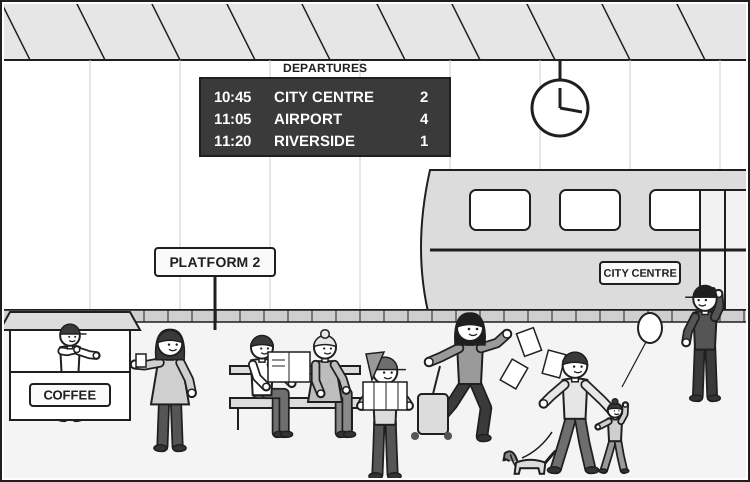
Describe the train station.

Line drawing of a busy train station platform with passengers, a guard, a coffee kiosk and a departures board.

What the speaker says · 152 words

This picture shows a busy train station platform in the morning. The clock says it’s nearly a quarter to eleven, and the board shows a train to the city centre at 10:45, so the train on the right is probably about to leave. On the left, a woman is buying a coffee at a small kiosk. Next to her, a man is reading a newspaper on a bench beside an older woman. In the middle, a tourist is studying a map — he looks a bit lost. Behind him, a woman is running for the train with her suitcase, and her papers are flying everywhere, so I think she’s late. On the right, a father is walking with his young child, who is holding a balloon, and a small dog is running around their feet. Finally, a guard next to the train is blowing his whistle, so the doors will close any second.

Why this answer works

  • Starts with the big picture (where and when), then moves around the scene in order from left to right.
  • Reads the small details — the clock, the departures board — and connects them into a little story.
  • Uses present continuous for actions and place phrases (on the left, next to, behind, in the middle).
  • Adds small predictions and interpretations (she’s late, he looks a bit lost, the doors will close) — these show higher-level language.
Speaking · Task 2Strong answer (around B2)

Task 2: a trip by train or bus

Task · 60 seconds

Tell me about a time when you travelled somewhere by train or bus.

What the speaker says · 134 words

Last year I took an overnight train from my hometown to the capital to visit my sister. I booked a bed in a sleeper carriage because the ticket was much cheaper than flying. At first I was a bit nervous, because I had never slept on a train before and I was sharing the compartment with three strangers. But one of them was a retired teacher who told me funny stories about his students, and we ended up talking until almost midnight. When I woke up the next morning, the train was passing through green hills covered in mist, which was really beautiful. The journey took fourteen hours, but it didn’t feel long at all. Since then I’ve preferred trains for long trips, because you actually see the country and sometimes meet interesting people.

Why this answer works

  • Sets the scene quickly: when, where, why.
  • Past simple and past perfect are used correctly to tell events in order.
  • A feeling at the start (nervous) and a change at the end (preferred trains) give the story a shape.
Speaking · Task 3Strong answer (around B2)

Task 3: car or public transport

Task · 60 seconds

Some people prefer to travel around their city by car. Others prefer public transport. Which do you prefer? Give your opinion and reasons to support it.

What the speaker says · 115 words

I definitely prefer public transport. The main reason is that it is less stressful. When I take the train to work, I can read, listen to podcasts or just relax, while drivers have to concentrate on the traffic the whole time. Another reason is cost: petrol and parking in the city centre are very expensive, but a monthly travel pass costs much less. I know a car is more convenient for families with small children or for people who live far from a station, and I would probably drive in that situation. But for most daily trips in a city, public transport is cheaper, calmer and better for the environment, so that is my choice.

Why this answer works

  • The opinion comes in the first sentence.
  • Two reasons, each explained with a concrete example.
  • The speaker accepts a point on the other side, then returns to the main opinion.
Speaking · Task 4Strong answer (around B2–C1)

Task 4: moving outside the city

Task · 90 seconds

Your friend works in the city centre but is thinking about renting an apartment in a small town an hour away, where rent is much cheaper.

What are the advantages and disadvantages of this idea?

What the speaker says · 185 words

Well, there are clear benefits to this plan. The biggest one is money: if the rent is much lower, your friend could save a lot every month, maybe enough to buy a car or even start saving for a house. A small town is also usually quieter and safer, with more green space, so their quality of life outside work could improve. They might even get a bigger apartment for the same price, which is important if they work from home sometimes.

On the other hand, the commute is a serious disadvantage. An hour each way means two hours a day, or about ten hours a week, spent travelling. That time and the cost of tickets or petrol could cancel out part of the savings. It could also be harder to see friends in the city after work, and if the trains are delayed or stop running late at night, your friend could feel quite isolated.

So overall, I think it is a good idea only if the transport connection is reliable and your friend doesn’t mind using the travel time to read or relax.

Why this answer works

  • Roughly equal time on advantages and disadvantages.
  • Each point is developed with a consequence (so, which is important if, could cancel out).
  • A short, conditional conclusion rounds off the answer without skipping the analysis.
Speaking · Task 5Strong answer (around B2–C1)

Task 5: a fee for driving into the city centre

Task · 90 seconds

The city council is considering a daily fee for cars that drive into the city centre. The money would be used to improve buses.

I am a member of the city council. Tell me what you think about this idea and try to convince me to agree with you.

What the speaker says · 204 words

Thank you for listening to me. I understand that a new fee might seem unpopular, but I strongly believe the council should introduce it.

First of all, the city centre has a traffic problem that is getting worse every year. Buses are stuck in the same jams as cars, so they are slow and people stop using them. A fee would reduce the number of cars, which means buses could run faster and more reliably straight away.

Secondly, the money goes directly into better buses, so drivers can see what they are paying for. More frequent services and new routes to the suburbs would give people a real alternative to driving. I know several neighbours who would happily leave their cars at home if the bus came every ten minutes.

Finally, think about the city’s image and health. Cleaner air and quieter streets make the centre more attractive for shoppers and tourists, which is good for local businesses in the long term.

Of course, the council should protect people who have no choice, for example by offering discounts for disabled drivers and delivery vans. But with those exceptions, I really believe this fee would benefit everyone, and I hope you will vote for it.

Why this answer works

  • Speaks directly to the listener and stays polite (I understand…, I hope you will vote for it).
  • Three reasons, each linked to what a council member cares about: traffic, value for money, the city’s image.
  • Answers a likely objection with a practical solution, then ends with a clear request.